
Distributed I/O: Expanding Industrial Automation Again

Industries are alive. They grow, evolve and their needs change over the years. New production processes, plant extensions, additional machinery or the modernisation of existing equipment mean that an industrial facility must be able to adapt to new market demands.
At SolutionForFactory we see industrial automation as a scalable system, designed not only to meet a factory’s current needs but also to support its future growth.
Once again this year, one of our long-standing clients has trusted us to extend the automation of a new area of their factory using distributed I/O, integrating it into the control system we installed several years ago.
Distributed I/O to expand an existing industrial facility
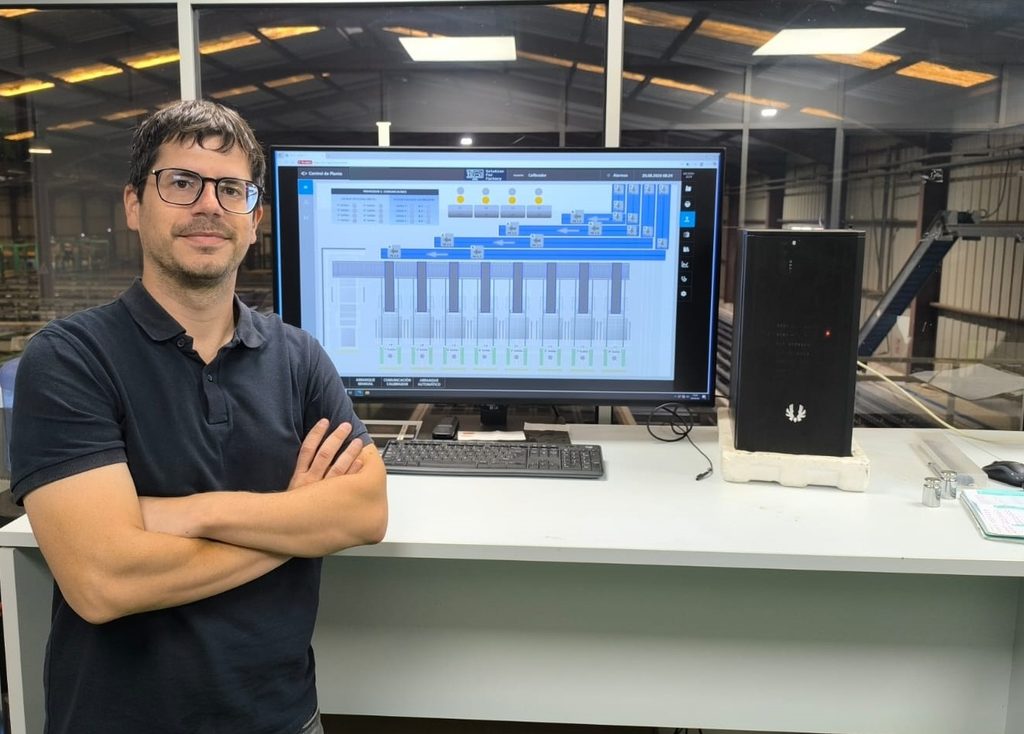
When we started working with this client, the initial project involved automating a specific area of the factory and installing a general SCADA system from which to control and monitor the facility.
However, a factory never stands still.
Over the years new needs arise: machines are added, production areas are extended, processes are modified and certain equipment becomes obsolete.
For this reason, we have been progressively expanding that original installation.
This year we returned to the factory to add new installations to the general SCADA and automate obsolete machinery, keeping to the growth philosophy we have followed throughout the various expansions.
What does distributed I/O bring?
Distributed I/O makes it possible to place input and output modules at different points of an industrial facility, close to the sensors, actuators and equipment they need to control.
Instead of concentrating all of a factory’s signals in a single location, we can distribute the control elements across the facility and connect them to the automation system.
This architecture is particularly useful when a business grows progressively, as it allows expansions to be planned in a more modular and scalable way.
In this project, distributed I/O has allowed us to increase the automated areas of the factory and incorporate them into the existing control system.
Automation built to grow
One of the key decisions when designing an industrial automation installation is to think beyond immediate needs.
From the initial project to successive expansions
Our client’s installation began by automating a specific area of the factory with a control system and a general SCADA.
Since that initial installation, production needs have evolved and every year we have carried out new work to expand the system.
The aim is for the new areas not to operate as completely independent installations, but to be integrated into the existing automation architecture.
In this way, the SCADA we installed years ago remains a cornerstone of the facility and allows new areas of the factory to be added progressively.
New areas controlled from the general SCADA
By installing distributed I/O, we have automated new areas so that they can be controlled and monitored from the plant’s general SCADA.
This makes it possible to keep making use of the existing infrastructure while the automation evolves alongside the factory’s needs.
Expanding an industrial business does not have to mean starting from scratch. When an installation is designed with its potential growth in mind, new elements can be added progressively and the system adapted to the needs that arise over time.
Modernising obsolete machinery
The growth of an industrial business is not just about installing new machinery.
Many factories have machines that still perform their function perfectly well mechanically, but whose electrical, control or automation systems have become obsolete.
Integrating existing machines into modern automation
As part of the expansions we carried out for this client, we also worked on the automation of obsolete machines, adapting them to the current needs of the facility.
Renewing these systems makes it possible to integrate existing equipment into a more modern automation architecture and, where the project requires it, connect it to the general supervision system.
In this way, the evolution of a factory can combine new installations with the upgrading of existing equipment.
Industry 4.0 also means scalability
When we talk about Industry 4.0, we should not think only about installing new devices or adopting new technologies.
A major part of it is ensuring that a factory’s different systems can communicate, exchange information and evolve together.
PLCs, HMIs, SCADA, distributed I/O and industrial networks are all part of an architecture that must meet current production needs while also being ready for future expansions.
A factory that evolves year after year
This project is a good example of that philosophy.
We started from an initial automated area and a general SCADA installed years ago. Since then, the factory has kept growing and we have supported that growth through a series of expansions.
This year we have added new areas using distributed I/O, integrated new installations into the general SCADA and worked on machinery whose automation needed upgrading.
And in a few years’ time the needs will probably be different again.
Because industries are alive.
As alive as our clients’ needs, and adapting to them is essential.
SolutionForFactory: industrial automation tailored to each factory
At SolutionForFactory, David Plaza provides specialist PLC, HMI and SCADA programming services, as well as carrying out installations and projects related to industrial automation and Industry 4.0.
We work on both new installations and the expansion and modernisation of existing systems, making sure each solution can adapt to the real needs of the business.
The ongoing trust of our clients allows us to get to know their facilities, understand how their processes evolve and keep developing their automation as their factory grows.
Need to expand the automation of your plant?
If your factory is growing and you need to add new areas to your existing control system, integrate distributed I/O, expand a SCADA or modernise machinery with obsolete automation systems, we can assess the needs of your facility.
SolutionForFactory — Industrial automation, PLC, HMI, SCADA and Industry 4.0.